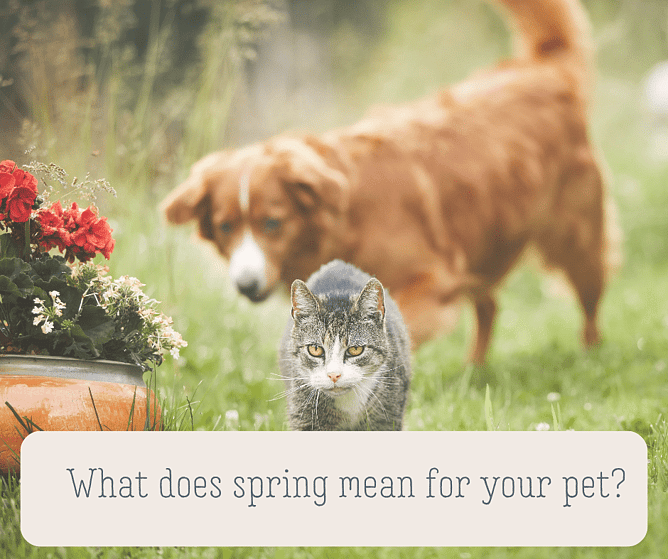
I love spring.
There is something about this time of year that just feels lighter. The days get longer, the sun starts to warm us up, plants burst into life and there is a real sense of growth, movement and new beginnings.
And our animals notice it too.
You may find your dog suddenly has more energy, your cat becomes more interested in heading outdoors, or your animal simply seems a little different as winter gives way to spring.
But what does that seasonal change actually mean for our animals?
As an animal homeopath, I'm always interested in how an individual animal responds to change. And spring is a fascinating time to observe them.
Spring Through A Homeopathic Lens
Homeopathy is all about the individual.
There isn't one remedy for “itchy animals in spring” or one remedy that every animal needs when the seasons change.
Instead, I'm interested in how that particular animal responds to the changes happening around them.
Two animals might both become itchy when spring arrives, but their overall picture could be completely different, meaning they may need a different remedy.
One might become restless and energetic. Another might become clingy or unsettled. Another may have changes in their digestion, sleep, appetite or behaviour alongside the itching.
The symptom itself is only one piece of the puzzle.
When I'm looking at an animal homeopathically, I'm interested in the whole picture. What has changed? How are they behaving? What else is going on? What makes things better or worse? How are they responding physically, mentally and emotionally?
Spring doesn't give every animal the same experience - and that's exactly why I don't believe in cookie-cutter solutions.
Instead, I look at the individual animal and the pattern they are presenting.
Spring Through A Traditional Chinese Medicine Lens
Although homeopathy is at the heart of my work, I also find Traditional Chinese Medicine fascinating.
When I'm working with an animal through kinesiology, I sometimes dip into TCM principles as another lens through which to explore what may be happening with that individual.
In TCM, spring is associated with the Wood element, along with the Liver and Gallbladder.
Wood represents growth, movement and expansion — which fits spring beautifully.
After the quieter, more inward energy of winter, nature starts moving again. Plants grow, animals become more active and there is a general sense of things expanding and coming back to life.
The Liver is associated with the smooth flow of energy through the body. When things aren't flowing as smoothly as they should, TCM may look at things such as stiffness, movement, digestion, skin and even behaviour.
Spring is also associated with Wind.
Wind is changeable. It can appear suddenly, move around and affect different areas. From a TCM perspective, this can be an interesting way of looking at symptoms that seem to move or change, such as itching, twitching, restlessness or some balance-related changes.
Again, this isn't about saying that every springtime change is a Liver imbalance or caused by Wind.
It's simply another way of looking at the animal as a whole.
And I love having different perspectives that help us ask better questions, allowing us to support and understand our pets more fully.
And Then There's “Spring Fever”!
Spring doesn't only bring physical changes. It can also bring some interesting behavioural changes.
Longer days mean more daylight, more activity and more happening in the environment around our animals.
Our animals can suddenly seem to come alive.
They may become more energetic, restless, vocal, excitable or interested in getting outside. Some may become more reactive to what is happening around them, while others seem to have suddenly discovered that the world is a very exciting place!
Cats in particular can really embrace spring.
In fact, last spring I had an influx of cats coming to me with behavioural symptoms.
It was fascinating to see how many cases seemed to appear around the same time of year.
So, if your normally settled cat suddenly seems to have developed a serious case of spring fever, you aren't necessarily imagining it!
Of course, behaviour can have many causes and a sudden change in behaviour shouldn't simply be put down to the season.
But it is another example of why I think it is so important to look at the bigger picture.
What Might You Notice This Spring?
As we move into spring, take a little time to observe your animal.
You may notice:
changes in their energy levels
increased excitement or restlessness
changes in behaviour or temperament
increased vocalisation or attention-seeking
changes in sleep
changes in appetite or digestion
increased itching
increased eye discharge
stiffness or changes in movement
a general sense that they are just “not quite themselves”
It doesn't mean that spring is necessarily the cause.
But a change is worth noticing.
Our animals are constantly responding to their environment, and sometimes these seasonal transitions can highlight patterns that we hadn't noticed before.
Don't Just Look At The Symptom
This is probably the biggest thing I want you to take away from this blog.
If your animal changes when spring arrives, don't immediately focus on the one symptom that has appeared.
Step back and look at the whole animal.
What else has changed?
Are they behaving differently?
Has their energy changed?
Are they sleeping differently?
Are they more reactive?
Has their appetite or digestion changed?
Are there other physical changes happening at the same time?
These details can tell us so much more about the individual animal than simply saying, “My dog is itchy in spring.”
And this is where individualised homeopathy can be so interesting.
Rather than treating the season, we look at the animal experiencing the season.
Spring Is A Time For Renewal
Spring is all about growth, movement and new beginnings.
Perhaps it is also a good time for us to slow down and really observe our animals.
Notice what changes.
Notice what stays the same.
Notice the little things.
Because our animals are constantly communicating with us, and sometimes the smallest changes can give us valuable information.
So, as we step into spring, get outside, enjoy the longer days, embrace a little bit of that spring energy and have some fun with your animals.
And if your animal seems to be experiencing more than just a little spring fever, remember that there is value in looking at the whole animal rather than simply the symptom.
Has Your Animal Changed With The Seasons?
If you've noticed changes in your animal as we've moved into spring and you're wondering whether homeopathy could be appropriate for them, an individual consultation allows us to explore their unique pattern rather than simply focusing on the symptom.
If you'd like to find out more about working with me, you can learn more about my animal homeopathy consultations here or get in touch to discuss whether a consultation may be appropriate for your animal.
And if you're curious about understanding your pet from another perspective, kinesiology offers another way of exploring the individual animal and what may be happening beneath the surface. If that calls to you, get in touch to find out more.