I recently took a step back from social media.
What started as a much-needed break from the constant noise quickly became something else entirely. It gave me space to reflect on the work I do, the animals I have worked with over the years, and the conversations I believe we still need to be having.
The truth is, after years of working with animals through my clients, fostering rescue animals in my own home, and witnessing firsthand the impact of homeopathy, I'm finding it harder and harder to stay silent.
I don't know about you, but because of the work I do, my social media feeds are filled with pets struggling with anxiety, gut issues, behavioural challenges, teething, chronic illness, and everything in between.
Mixed in with that is a constant stream of people telling you what you should and shouldn't be doing, and products claiming to be the answer to every problem.
Let's just say I needed a break from it all.
And honestly? It was bliss.
What I Have Witnessed
During that break, I realised just how much I had been holding back.
Most people don't realise that homeopathy is very heavily scrutinised. There are many things I cannot say publicly. I have to be careful with my wording and the claims I make.
Yet every day I see advertisements and posts promoting products with promises and guarantees about what they can do for animals.
That can be incredibly frustrating.
What many people don't know is that homeopathy has been used around the world for over 200 years and continues to be used by practitioners, veterinarians, doctors, and families who have witnessed its effects firsthand.
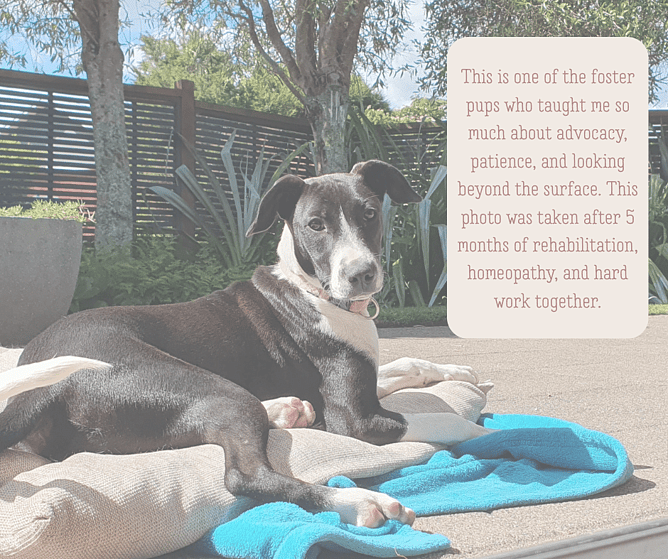
I too have witnessed the effects of this wonderful medicine in my own pets, my own health, in the many animals I have had the privilege of working with through my clients, and in the foster animals that came through my home.
In many cases, if I wanted these rescue animals to receive homeopathic support, I had no choice but to bring them into my own home and care. It simply wasn’t something that could be done within the rescue environment itself. So that part of the work happened outside of it, quietly, in my own space.
I poured countless hours into those animals. Hours spent observing, learning, prescribing remedies, and watching as each layer slowly peeled away, revealing the animal underneath.
There were massage sessions on the lounge floor, hydrotherapy sessions in my own bathtub, and many late nights trying to give them the support they needed when resources were limited.
Regardless of the changes I observed, or the outcomes achieved, homeopathy was rarely acknowledged. There were times when veterinarians would remark on how well an animal was doing, yet the homeopathic support they had received remained invisible in the conversation.
That is frustrating.
Not because I need recognition.
But because I know what went into helping those animals. I know the hours, the dedication, the setbacks, the observations, and the changes that unfolded over time - including the very real changes I witnessed when homeopathy was a big part of their care.
I wasn’t watching from a distance. I was there for all of it. The small shifts, the slow unfolding, the moments where something changed after a long period of stagnation.
Working at the animal’s pace - what I often think of as nature’s pace - observing, responding, and allowing things to unfold as they needed to.
The Questions I Keep Coming Back To
And over the years, experiences like this have shaped the way I now look at other situations as well.
Recently I am seeing and reading about young puppies, not even six months old, being placed on multiple medications for behavioural concerns.
And I can’t help but feel that in many cases we are reaching for quick fixes because we want the behaviour to stop immediately, rather than asking what the behaviour is actually communicating.
I keep coming back to this - are we truly looking deeply enough at why these issues are occurring in the first place, or are we too quick to suppress what the animal is trying to express?
We seem to live in a world that wants quick fixes.
If we can't see something happening immediately, then perhaps we assume it isn't happening at all.
What frustrates me most is not that people disagree with homeopathy.
It's that many people dismiss it without ever taking the time to understand it.
Why I Am Speaking More Openly
Over the years, I have seen animals whose lives have been changed through an integrative approach that includes homeopathy. I've also seen opportunities missed because people were unwilling to even consider it as part of a broader treatment plan.
I truly hope that within my lifetime we see a shift towards greater openness, curiosity, and respectful discussion around all forms of healthcare and healing.
As I sit here contemplating the future of animal homeopathy, I realise it doesn't make me want to step back.
It makes me want to step forward.
It makes me want to educate more.
To share more.
To have the conversations that aren't always comfortable.
Because our animals deserve advocates who are willing to ask questions, seek understanding, and explore all available options.
I often think about Dr. Samuel Hahnemann, the German physician who founded homeopathy.
He was a respected physician of his time, yet when he began developing the foundations of homeopathy, he was ridiculed, criticised, and mocked for his ideas.
History is full of people who have challenged accepted thinking and faced resistance for doing so.
People often fear what they don't know or don't yet understand.
I am certainly not comparing myself to Hahnemann, but I do sometimes reflect on the courage it must have taken to continue speaking about something he believed in despite the criticism that followed.
Putting yourself out there is scary.
Sharing your beliefs publicly is scary.
Knowing you may be judged is scary.
But perhaps that is the price we pay when we choose to have conversations that challenge people's existing beliefs.
I'm increasingly feeling that now is the time to speak more openly about what I have witnessed, what I have learned, and why I remain so passionate about animal homeopathy.
Not because I expect everyone to agree.
But because our animals deserve the conversation.
Looking Forward
There is a place for both conventional treatment and homeopathy. At the end of the day, I would like to think that we all have the animal's best interests at heart.
Nothing less.
Nothing more.
I don't expect everyone to agree with me.
I don't expect everyone to share my perspective.
But I do believe our animals deserve thoughtful conversations, curiosity, and a willingness to ask questions.
After years of working with animals, that is perhaps what I have become most passionate about.
Not convincing people.
Not winning arguments.
But advocating for animals and encouraging people to look a little deeper.
Because sometimes the most important things an animal is trying to tell us are the things that can't be seen on the surface.
Further Reading
If this article resonates with you and you would like to see an example of this work in practice, I wrote an article several years ago about one of my rescue rehabilitation cases that was published in Hpathy, a worldwide homeopathic journal.
It follows the journey of one particular animal, the challenges we faced, and the role homeopathy played along the way.